
On this page · 4 sections
Technology has always changed the way we work.
Spreadsheets made calculations easier. Business intelligence tools made reporting faster. Automation took care of many repetitive tasks. Cloud tools made information easier to access and share.
Now AI is taking that change even further.
For businesses trying to get more done with less time and fewer resources, this can be a big help. AI can analyze data, prepare reports, create presentations, answer questions and handle tasks that used to take hours.
But there is an important point we should not overlook:
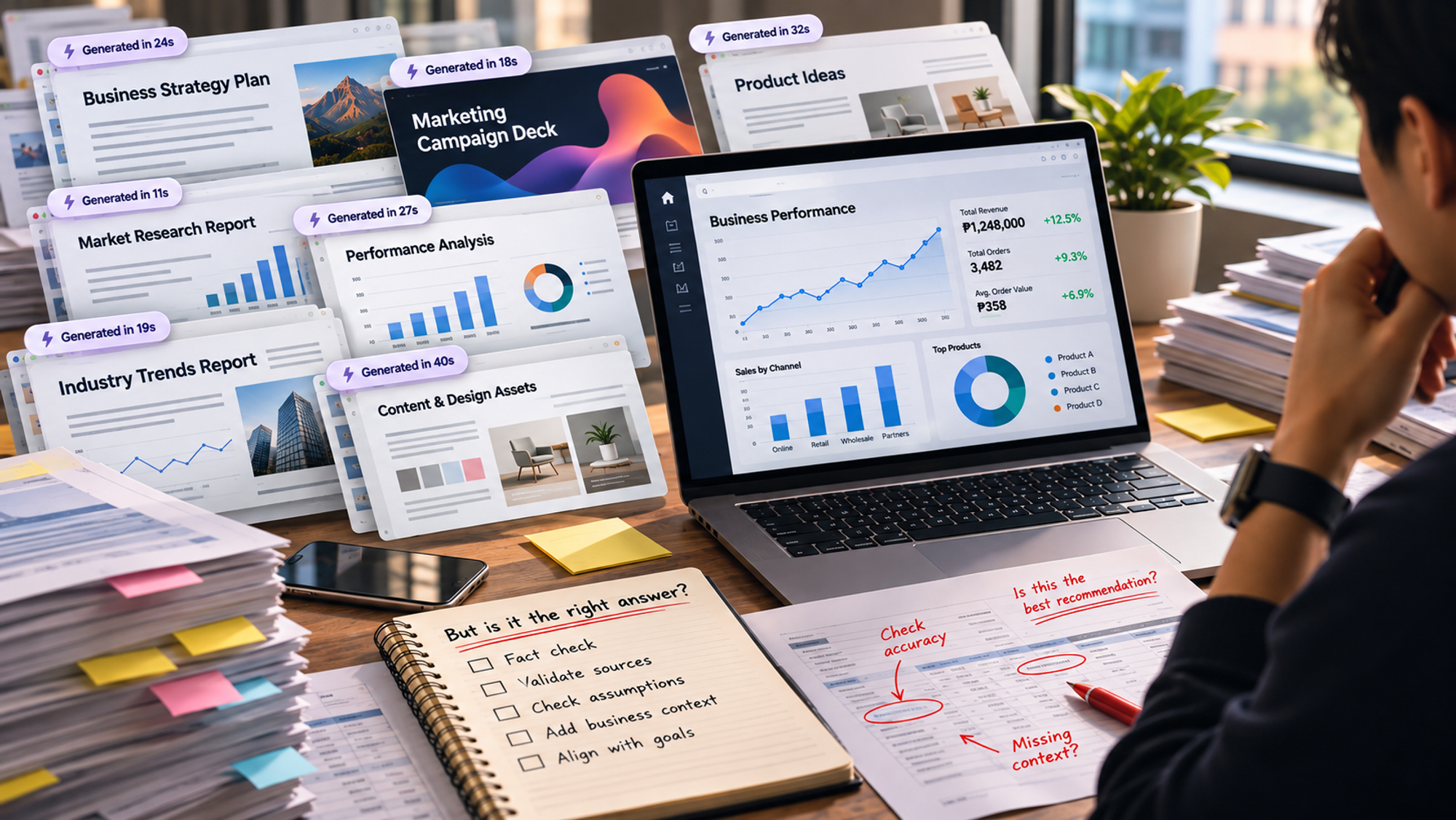
Getting an answer faster does not always mean getting a better answer.
A person can create a great-looking dashboard without fully understanding the data behind it.
A report can be generated automatically without anyone checking whether the numbers actually make sense.
AI can create a polished presentation without knowing what the audience really needs to hear.
Something can look finished without actually being finished.
AI is powerful, but it has limits
A study by researchers from Harvard Business School, Boston Consulting Group, MIT, the University of Pennsylvania and other institutions gives us a useful example.
The researchers looked at how consultants performed when they used AI for different types of work.
They found that AI helped people work faster and produce better results on tasks within its capabilities. Across 18 tasks, participants using AI completed 12.2% more tasks and did so 25.1% faster on average.
However, on a complex managerial task outside AI's capabilities, participants using AI were 19% less likely to produce a correct solution than those who did not use AI.
The researchers called this the "jagged technological frontier" — the idea that AI can be very good at some tasks while still being unreliable at others (Dell’Acqua et al., 2026).
The lesson is not that we should stop using AI.
The lesson is that we need to understand the work well enough to know when we can trust the output and when we need to check it.
People still need to understand the work
Think about a typical business in the Philippines.
You might have a CRM, a dashboard and an AI tool that summarises your sales pipeline.
The technology can give you the information quickly.
But someone still needs to understand what that information means.
They need to ask:
- Are these numbers correct?
- What changed?
- Why did it change?
- Which opportunities need attention?
- Is the data showing us something real, or is there a problem with the data?
- What should we do next?
AI can help with some of these questions.
But people still need to provide the context and make the decision.
This shouldn't depend entirely on people remembering to check AI's work.
Businesses need to build validation into the process itself. This could mean checking outputs against existing business rules, flagging inconsistencies, requiring approval for certain decisions, or routing exceptions to the right person.
The goal isn't to put a human in front of every AI-generated output. It's to make sure the right checks happen at the right points in the workflow.
The same applies to presentations and reports.
AI can create ten slides in seconds. But that does not mean you need ten slides.
A report can arrive in your inbox every Monday morning. But if nobody checks whether it is still useful, you may simply be producing the same information every week without doing anything with it.
Automation can save time. It does not replace judgment.
What this means for Philippine businesses
For businesses in the Philippines, there is a real opportunity.
Many organizations are looking at ways to improve their processes, use their data better and bring AI into their everyday work.
But the answer is not simply to buy more technology.
It also means looking at how work actually moves across the organization.
A business might introduce AI to generate sales reports, but if the underlying data is incomplete or different teams maintain separate records, the output will still be unreliable.
A business might automate customer inquiries, but if the AI cannot access accurate inventory, pricing, or order information, it may create more problems than it solves.
The technology can only be as useful as the processes, information, and decisions around it.
This is why successful AI adoption requires more than introducing another tool. It requires understanding the existing workflow, identifying where work gets delayed or repeated, and determining where AI can genuinely improve the process.
Sometimes the biggest opportunity isn't automating an entire department. It might be removing a manual step, connecting two disconnected systems, or giving a team the information they need without having to chase it across multiple tools.
The goal is not to introduce AI everywhere. It's to make the work better.
This means building technology and people's ability to work with it together.
Give people better tools, but teach them to question the results.
Automate repetitive work, but make sure people understand the process being automated.
Use AI to help with analysis, but make sure people can still read the results, spot problems and decide what to do next.
Because when everyone has access to increasingly powerful tools, knowing how to use the tool will no longer be enough.
The bigger skill may be knowing what to do with the output.
Ask:
- What are we actually trying to solve?
- What information do we need?
- What can we trust?
- What should we check?
- What might we be missing?
- What should we do next?
AI can give us an answer. Someone still needs to decide whether it is the right answer.
AI can help us move faster.
But moving faster only helps if we are moving in the right direction.
For businesses, the opportunity isn't simply to produce more output in less time. It's to build better ways of working, where technology handles what it does well and people can focus on the decisions that matter.
Make AI work inside your business
At ScaleXY, we work with businesses to identify operational bottlenecks and build AI-powered systems that improve how work gets done.
From connecting disconnected systems to automating repetitive workflows, we focus on practical improvements that reduce manual work, improve visibility, and help businesses operate more efficiently.
You don't need to automate everything at once. Start with one workflow, demonstrate its value, and build from there.
Have a process in your business that takes too much time, involves too much manual work, or creates unnecessary friction?
Reference
Dell’Acqua, F., McFowland III, E., Mollick, E., Lifshitz, H., Kellogg, K. C., Rajendran, S., Krayer, L., Candelon, F., & Lakhani, K. R. (2026). Navigating the jagged technological frontier: Field experimental evidence of the effects of artificial intelligence on knowledge worker productivity and quality. Organization Science, 37(2), 403–423. https://doi.org/10.1287/orsc.2025.21838
Next articleAI Slop Isn't Just Bad Content. It's a Business Problem.AI